
Sep 29, 2026
By Victor Teran
How Much Does a UX Audit Cost? Published Prices From $499 to $10,000
Published UX audit prices run from $499 for one flow to $10,000 and up for a full product review, with software from $49 a month. The price matters less than one question: does the audit name the screen that costs you money?
Design
UX
Audits
A UX audit costs anywhere from $49 a month for software to $10,000 and up for an agency review. We pulled those numbers from the providers' own price pages on 22 September 2026, not from blog estimates.
Most founders shopping for an audit compare prices. The useful comparison is what each audit is graded against: a checklist of usability rules, or your funnel data. The first tells you what is wrong with your screens. The second tells you which screen is costing you money, and how much.
Key takeaways
As of September 2026, published UX audit prices run from $499 for one flow (WANDR) to a $10,000 starting price for a full review (Convergine), and automated tools charge $49 to $499 a month (UXAudit.Now).
Several of the cheapest published human audits are built for Shopify stores, not SaaS products, so check what a price was designed for before you compare it.
A heuristic audit grades screens against usability rules and ranks issues by severity. A funnel audit starts from your analytics and ranks issues by what they cost. They are different products sold at overlapping prices.
At $15k MRR, a leak costing 10% of revenue is $18,000 a year. That is the number any audit should be priced against.
OTU's Growth Audit runs three weeks, starts from your analytics rather than a checklist, and its fee credits into a Growth Sprint booked within 60 days. We quote it on the call.
How much does a UX audit cost in 2026?
Published prices run from $49 a month for automated software to $10,000 and up for a full agency review, and the research consultancies do not publish an audit price at all.
Most "UX audit cost" articles are written by studios quoting ranges with no source behind them. So we only list a band where a provider publishes its own price. Every figure below is as of September 2026, taken from that provider's page.
Type | Published price (September 2026) | What the price buys | Source |
|---|---|---|---|
Automated tool | $49 to $499 a month | AI and manual audits of any public URL, 5 manual audits a month on the $49 plan | |
Automated tool, research library | From $200 a month ($2,400 billed annually) | UX guidelines plus a site scanner, built around ecommerce research | |
Freelancer | No published price we could cite | Quoted per project or per hour on marketplaces | None |
Productized studio | Free (3 friction points) or $499 (one major flow, 5 business days) | Prioritized recommendations, annotated screens, a PDF and a walkthrough | |
Productized studio | From $1,000; $2,500 to $5,000 for complex or enterprise software | Most audits delivered within 2 weeks, quote depends on screen count | |
Productized studio, ecommerce | $500 (one page) or $1,900 (full store) | Shopify store review with Figma redesigns | |
Productized studio, ecommerce | $2,250 (Oddit Essential) | Report plus redesigned sections, navigation and cart included | |
Full-service agency | From $10,000 | Eight areas, from navigation to accessibility to SEO, with prioritized recommendations | |
Research consultancy | Not published | NN/g lists an expert review; it says its consulting projects typically range from $40K to $200K. Baymard prices its audit service to the organization |
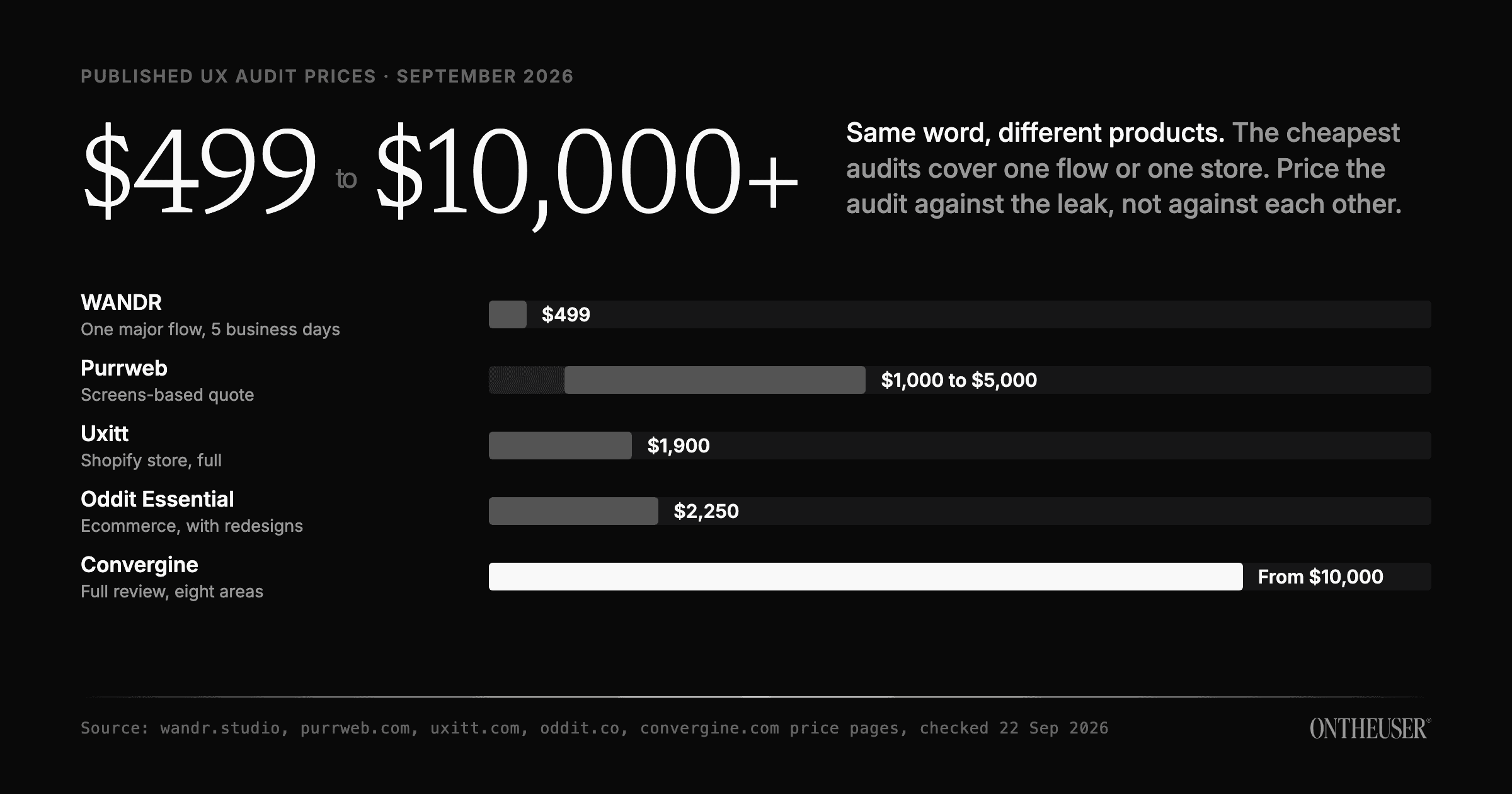
One-off prices as published on each provider's page, 22 September 2026. Monthly software left out so like is compared with like.
Two things jump out. First, the cheapest human audits on this list are not SaaS audits. Uxitt prices a Shopify store review, and Oddit's packages redesign navigation and cart pages. A $1,900 store audit says nothing about what a SaaS onboarding audit should cost.
Second, freelancers have no number. We could not find a freelancer price page stable enough to cite, because freelancers quote per project or by the hour and marketplace listings change daily. If someone hands you a "freelancer band" with no link behind it, treat it as a guess.
What does each type of UX audit actually buy you?
The cheaper the audit, the more of it is a rule set applied to screens; the more expensive, the more breadth and research it adds.
Automated tools scan what they can reach. UXAudit.Now says it audits any public URL from the outside, which means it sees what a logged-out visitor sees. For a SaaS product, the leak usually sits behind the login, in the first session after signup.
Productized studios sell a fixed scope for a fixed price. WANDR's $499 audit covers one major flow in 5 business days and, by its own count, identifies an average of 12 high-impact friction points per audit. Purrweb starts at $1,000 and delivers most audits within 2 weeks.
Agencies and consultancies sell breadth: Convergine's $10,000 review covers eight areas. What almost none of these price pages say is where the audit starts. That decides whether it is worth the money.
FREE GUIDE
The 4 product leaks costing you growth
A short audit guide for founders. Find the four places your product leaks revenue, and what to fix first.
Why is a heuristic UX audit a different product from a funnel audit?
A heuristic audit grades every screen against usability rules; a funnel audit starts from your data, finds the step where users leave, and only then looks at screens.
The heuristic method is well established. An expert inspects the product against a set of rules, most often Jakob Nielsen's 10 usability heuristics, and NN/g describes an expert review as a more general version of a heuristic evaluation (NN/g). The output is a list of issues ranked by severity.
Severity is not cost. A confusing icon on the settings page and a confusing field on step two of signup can both score "major". Only one of them sits in front of every new user. A report that ranks them side by side hands your team twelve fixes and no order that matches revenue.
A funnel audit runs the other way. Instrument the new-user path, find the steepest drop, watch session replays of people failing at that exact step, then examine the screens involved. The result is shorter and sharper: this screen, this stumble, this much money.
That is how the Q.AI diagnosis worked. Their stack was Amplitude. The funnel showed the cliff in onboarding, replays showed why, and only the implicated screens were redesigned, with no new features shipped. Activation went from 38% to 67%, onboarding completion rose 68%, and support tickets fell 73%. The full sequence is in how Q.AI took activation from 38% to 67%.
It is also why a redesign so often fails to move the numbers. It spreads attention evenly across forty screens when the problem sits on one or two.
How do you know if a UX audit is worth the price?
Price the audit against the leak, not against other audits.
Run the napkin math. At $15k MRR, a leak costing 10% of revenue is $18,000 a year ($15,000 times 12 months times 10%). That is $1,500 a month walking out of the product.
A $499 audit that finds twelve issues and ranks the expensive one ninth is not cheap. An audit that names that leak and ranks its fix first pays for itself in months, at four figures or five.
The inverse holds too. If you have no live users, there is no funnel to read, and a heuristic review of your screens is the right tool at the right price. A funnel audit on an empty funnel is guessing with extra steps.
What should you get in a UX audit report?
A short ranked list tied to your numbers, with evidence behind every item, not a long list tied to a checklist.
Before you pay anyone, ask whether the report will include these eight things:
Your baseline in numbers. Activation, onboarding completion or conversion on the path the audit covers, measured on a fixed window.
The steepest drop, named. The funnel step where most users leave, with the share lost there.
Evidence for why they leave. Session replays or recordings of real users failing at that step, not an expert's opinion of the screen.
The implicated screens. Each one annotated with the stumble someone actually observed.
A ranking by impact, effort and urgency. Severity alone does not tell you what to fix first.
A cost per leak. Even a rough one, so the ranking carries a dollar sign.
A measurement plan. Which metric you check after the fix, on which cohort, against which baseline.
A handover conversation with the person who did the work, not an account manager.
If a provider cannot promise items 1 to 3, you are buying a heuristic review. That can be the right purchase. Just pay heuristic prices for it. For the patterns that tend to show up in item 4, the SaaS onboarding teardown lists the seven we see most.
What does OTU's Growth Audit include?
Three weeks, a teardown across conversion, onboarding, activation and churn, and a plan ranked by impact, effort and urgency.
We held every other provider to its published scope, so here is ours in full:
Growth Audit | Detail |
|---|---|
Timeline | 3 weeks |
Teardown | Conversion, onboarding, activation and churn |
Analysis | Analytics review, funnel analysis, session replay analysis |
Also included | Brand trust assessment, one AI opportunity assessment |
What you receive | A prioritized action plan ranked by impact, effort and urgency, plus a 60-minute handover call |
Not included | Implementation. That is the Growth Sprint |
Fee credit | The full fee credits into a Growth Sprint booked within 60 days |
It sits above a productized flow audit, because it starts from your analytics and covers four leak areas rather than one flow, and below the full-agency tier, because it is scoped to where your numbers break rather than to eight review categories. The fee is fixed and we quote it on the call.
Is the free Growth Teardown a UX audit?
No. The free 30-minute Growth Teardown is the diagnosis: where the leak is, which screen, and why it costs money.
It runs live, inside your product and your data. You leave knowing what is broken and where we would start. The prioritized fix plan, the instrumented funnel and the replay analysis are the paid Growth Audit, and we say that before the call rather than on it.
That line is deliberate. A free call that pretends to hand over the whole plan is a sales pitch dressed up as a report. If your number is stuck and nobody can say which screen is doing it, that half hour costs nothing and tells you whether a paid audit is worth spending on at all.
WHAT NEXT
Want this fixed in your product, not just explained?



Sep 29, 2026
By Victor Teran
How Much Does a UX Audit Cost? Published Prices From $499 to $10,000
Published UX audit prices run from $499 for one flow to $10,000 and up for a full product review, with software from $49 a month. The price matters less than one question: does the audit name the screen that costs you money?
Design
UX
Audits
A UX audit costs anywhere from $49 a month for software to $10,000 and up for an agency review. We pulled those numbers from the providers' own price pages on 22 September 2026, not from blog estimates.
Most founders shopping for an audit compare prices. The useful comparison is what each audit is graded against: a checklist of usability rules, or your funnel data. The first tells you what is wrong with your screens. The second tells you which screen is costing you money, and how much.
Key takeaways
As of September 2026, published UX audit prices run from $499 for one flow (WANDR) to a $10,000 starting price for a full review (Convergine), and automated tools charge $49 to $499 a month (UXAudit.Now).
Several of the cheapest published human audits are built for Shopify stores, not SaaS products, so check what a price was designed for before you compare it.
A heuristic audit grades screens against usability rules and ranks issues by severity. A funnel audit starts from your analytics and ranks issues by what they cost. They are different products sold at overlapping prices.
At $15k MRR, a leak costing 10% of revenue is $18,000 a year. That is the number any audit should be priced against.
OTU's Growth Audit runs three weeks, starts from your analytics rather than a checklist, and its fee credits into a Growth Sprint booked within 60 days. We quote it on the call.
How much does a UX audit cost in 2026?
Published prices run from $49 a month for automated software to $10,000 and up for a full agency review, and the research consultancies do not publish an audit price at all.
Most "UX audit cost" articles are written by studios quoting ranges with no source behind them. So we only list a band where a provider publishes its own price. Every figure below is as of September 2026, taken from that provider's page.
Type | Published price (September 2026) | What the price buys | Source |
|---|---|---|---|
Automated tool | $49 to $499 a month | AI and manual audits of any public URL, 5 manual audits a month on the $49 plan | |
Automated tool, research library | From $200 a month ($2,400 billed annually) | UX guidelines plus a site scanner, built around ecommerce research | |
Freelancer | No published price we could cite | Quoted per project or per hour on marketplaces | None |
Productized studio | Free (3 friction points) or $499 (one major flow, 5 business days) | Prioritized recommendations, annotated screens, a PDF and a walkthrough | |
Productized studio | From $1,000; $2,500 to $5,000 for complex or enterprise software | Most audits delivered within 2 weeks, quote depends on screen count | |
Productized studio, ecommerce | $500 (one page) or $1,900 (full store) | Shopify store review with Figma redesigns | |
Productized studio, ecommerce | $2,250 (Oddit Essential) | Report plus redesigned sections, navigation and cart included | |
Full-service agency | From $10,000 | Eight areas, from navigation to accessibility to SEO, with prioritized recommendations | |
Research consultancy | Not published | NN/g lists an expert review; it says its consulting projects typically range from $40K to $200K. Baymard prices its audit service to the organization |
One-off prices as published on each provider's page, 22 September 2026. Monthly software left out so like is compared with like.
Two things jump out. First, the cheapest human audits on this list are not SaaS audits. Uxitt prices a Shopify store review, and Oddit's packages redesign navigation and cart pages. A $1,900 store audit says nothing about what a SaaS onboarding audit should cost.
Second, freelancers have no number. We could not find a freelancer price page stable enough to cite, because freelancers quote per project or by the hour and marketplace listings change daily. If someone hands you a "freelancer band" with no link behind it, treat it as a guess.
What does each type of UX audit actually buy you?
The cheaper the audit, the more of it is a rule set applied to screens; the more expensive, the more breadth and research it adds.
Automated tools scan what they can reach. UXAudit.Now says it audits any public URL from the outside, which means it sees what a logged-out visitor sees. For a SaaS product, the leak usually sits behind the login, in the first session after signup.
Productized studios sell a fixed scope for a fixed price. WANDR's $499 audit covers one major flow in 5 business days and, by its own count, identifies an average of 12 high-impact friction points per audit. Purrweb starts at $1,000 and delivers most audits within 2 weeks.
Agencies and consultancies sell breadth: Convergine's $10,000 review covers eight areas. What almost none of these price pages say is where the audit starts. That decides whether it is worth the money.
FREE GUIDE
The 4 product leaks costing you growth
A short audit guide for founders. Find the four places your product leaks revenue, and what to fix first.
Why is a heuristic UX audit a different product from a funnel audit?
A heuristic audit grades every screen against usability rules; a funnel audit starts from your data, finds the step where users leave, and only then looks at screens.
The heuristic method is well established. An expert inspects the product against a set of rules, most often Jakob Nielsen's 10 usability heuristics, and NN/g describes an expert review as a more general version of a heuristic evaluation (NN/g). The output is a list of issues ranked by severity.
Severity is not cost. A confusing icon on the settings page and a confusing field on step two of signup can both score "major". Only one of them sits in front of every new user. A report that ranks them side by side hands your team twelve fixes and no order that matches revenue.
A funnel audit runs the other way. Instrument the new-user path, find the steepest drop, watch session replays of people failing at that exact step, then examine the screens involved. The result is shorter and sharper: this screen, this stumble, this much money.
That is how the Q.AI diagnosis worked. Their stack was Amplitude. The funnel showed the cliff in onboarding, replays showed why, and only the implicated screens were redesigned, with no new features shipped. Activation went from 38% to 67%, onboarding completion rose 68%, and support tickets fell 73%. The full sequence is in how Q.AI took activation from 38% to 67%.
It is also why a redesign so often fails to move the numbers. It spreads attention evenly across forty screens when the problem sits on one or two.
How do you know if a UX audit is worth the price?
Price the audit against the leak, not against other audits.
Run the napkin math. At $15k MRR, a leak costing 10% of revenue is $18,000 a year ($15,000 times 12 months times 10%). That is $1,500 a month walking out of the product.
A $499 audit that finds twelve issues and ranks the expensive one ninth is not cheap. An audit that names that leak and ranks its fix first pays for itself in months, at four figures or five.
The inverse holds too. If you have no live users, there is no funnel to read, and a heuristic review of your screens is the right tool at the right price. A funnel audit on an empty funnel is guessing with extra steps.
What should you get in a UX audit report?
A short ranked list tied to your numbers, with evidence behind every item, not a long list tied to a checklist.
Before you pay anyone, ask whether the report will include these eight things:
Your baseline in numbers. Activation, onboarding completion or conversion on the path the audit covers, measured on a fixed window.
The steepest drop, named. The funnel step where most users leave, with the share lost there.
Evidence for why they leave. Session replays or recordings of real users failing at that step, not an expert's opinion of the screen.
The implicated screens. Each one annotated with the stumble someone actually observed.
A ranking by impact, effort and urgency. Severity alone does not tell you what to fix first.
A cost per leak. Even a rough one, so the ranking carries a dollar sign.
A measurement plan. Which metric you check after the fix, on which cohort, against which baseline.
A handover conversation with the person who did the work, not an account manager.
If a provider cannot promise items 1 to 3, you are buying a heuristic review. That can be the right purchase. Just pay heuristic prices for it. For the patterns that tend to show up in item 4, the SaaS onboarding teardown lists the seven we see most.
What does OTU's Growth Audit include?
Three weeks, a teardown across conversion, onboarding, activation and churn, and a plan ranked by impact, effort and urgency.
We held every other provider to its published scope, so here is ours in full:
Growth Audit | Detail |
|---|---|
Timeline | 3 weeks |
Teardown | Conversion, onboarding, activation and churn |
Analysis | Analytics review, funnel analysis, session replay analysis |
Also included | Brand trust assessment, one AI opportunity assessment |
What you receive | A prioritized action plan ranked by impact, effort and urgency, plus a 60-minute handover call |
Not included | Implementation. That is the Growth Sprint |
Fee credit | The full fee credits into a Growth Sprint booked within 60 days |
It sits above a productized flow audit, because it starts from your analytics and covers four leak areas rather than one flow, and below the full-agency tier, because it is scoped to where your numbers break rather than to eight review categories. The fee is fixed and we quote it on the call.
Is the free Growth Teardown a UX audit?
No. The free 30-minute Growth Teardown is the diagnosis: where the leak is, which screen, and why it costs money.
It runs live, inside your product and your data. You leave knowing what is broken and where we would start. The prioritized fix plan, the instrumented funnel and the replay analysis are the paid Growth Audit, and we say that before the call rather than on it.
That line is deliberate. A free call that pretends to hand over the whole plan is a sales pitch dressed up as a report. If your number is stuck and nobody can say which screen is doing it, that half hour costs nothing and tells you whether a paid audit is worth spending on at all.
WHAT NEXT
Want this fixed in your product, not just explained?
Sep 29, 2026
By Victor Teran
How Much Does a UX Audit Cost? Published Prices From $499 to $10,000
Published UX audit prices run from $499 for one flow to $10,000 and up for a full product review, with software from $49 a month. The price matters less than one question: does the audit name the screen that costs you money?
Design
UX
Audits
A UX audit costs anywhere from $49 a month for software to $10,000 and up for an agency review. We pulled those numbers from the providers' own price pages on 22 September 2026, not from blog estimates.
Most founders shopping for an audit compare prices. The useful comparison is what each audit is graded against: a checklist of usability rules, or your funnel data. The first tells you what is wrong with your screens. The second tells you which screen is costing you money, and how much.
Key takeaways
As of September 2026, published UX audit prices run from $499 for one flow (WANDR) to a $10,000 starting price for a full review (Convergine), and automated tools charge $49 to $499 a month (UXAudit.Now).
Several of the cheapest published human audits are built for Shopify stores, not SaaS products, so check what a price was designed for before you compare it.
A heuristic audit grades screens against usability rules and ranks issues by severity. A funnel audit starts from your analytics and ranks issues by what they cost. They are different products sold at overlapping prices.
At $15k MRR, a leak costing 10% of revenue is $18,000 a year. That is the number any audit should be priced against.
OTU's Growth Audit runs three weeks, starts from your analytics rather than a checklist, and its fee credits into a Growth Sprint booked within 60 days. We quote it on the call.
How much does a UX audit cost in 2026?
Published prices run from $49 a month for automated software to $10,000 and up for a full agency review, and the research consultancies do not publish an audit price at all.
Most "UX audit cost" articles are written by studios quoting ranges with no source behind them. So we only list a band where a provider publishes its own price. Every figure below is as of September 2026, taken from that provider's page.
Type | Published price (September 2026) | What the price buys | Source |
|---|---|---|---|
Automated tool | $49 to $499 a month | AI and manual audits of any public URL, 5 manual audits a month on the $49 plan | |
Automated tool, research library | From $200 a month ($2,400 billed annually) | UX guidelines plus a site scanner, built around ecommerce research | |
Freelancer | No published price we could cite | Quoted per project or per hour on marketplaces | None |
Productized studio | Free (3 friction points) or $499 (one major flow, 5 business days) | Prioritized recommendations, annotated screens, a PDF and a walkthrough | |
Productized studio | From $1,000; $2,500 to $5,000 for complex or enterprise software | Most audits delivered within 2 weeks, quote depends on screen count | |
Productized studio, ecommerce | $500 (one page) or $1,900 (full store) | Shopify store review with Figma redesigns | |
Productized studio, ecommerce | $2,250 (Oddit Essential) | Report plus redesigned sections, navigation and cart included | |
Full-service agency | From $10,000 | Eight areas, from navigation to accessibility to SEO, with prioritized recommendations | |
Research consultancy | Not published | NN/g lists an expert review; it says its consulting projects typically range from $40K to $200K. Baymard prices its audit service to the organization |
One-off prices as published on each provider's page, 22 September 2026. Monthly software left out so like is compared with like.
Two things jump out. First, the cheapest human audits on this list are not SaaS audits. Uxitt prices a Shopify store review, and Oddit's packages redesign navigation and cart pages. A $1,900 store audit says nothing about what a SaaS onboarding audit should cost.
Second, freelancers have no number. We could not find a freelancer price page stable enough to cite, because freelancers quote per project or by the hour and marketplace listings change daily. If someone hands you a "freelancer band" with no link behind it, treat it as a guess.
What does each type of UX audit actually buy you?
The cheaper the audit, the more of it is a rule set applied to screens; the more expensive, the more breadth and research it adds.
Automated tools scan what they can reach. UXAudit.Now says it audits any public URL from the outside, which means it sees what a logged-out visitor sees. For a SaaS product, the leak usually sits behind the login, in the first session after signup.
Productized studios sell a fixed scope for a fixed price. WANDR's $499 audit covers one major flow in 5 business days and, by its own count, identifies an average of 12 high-impact friction points per audit. Purrweb starts at $1,000 and delivers most audits within 2 weeks.
Agencies and consultancies sell breadth: Convergine's $10,000 review covers eight areas. What almost none of these price pages say is where the audit starts. That decides whether it is worth the money.
FREE GUIDE
The 4 product leaks costing you growth
A short audit guide for founders. Find the four places your product leaks revenue, and what to fix first.
Why is a heuristic UX audit a different product from a funnel audit?
A heuristic audit grades every screen against usability rules; a funnel audit starts from your data, finds the step where users leave, and only then looks at screens.
The heuristic method is well established. An expert inspects the product against a set of rules, most often Jakob Nielsen's 10 usability heuristics, and NN/g describes an expert review as a more general version of a heuristic evaluation (NN/g). The output is a list of issues ranked by severity.
Severity is not cost. A confusing icon on the settings page and a confusing field on step two of signup can both score "major". Only one of them sits in front of every new user. A report that ranks them side by side hands your team twelve fixes and no order that matches revenue.
A funnel audit runs the other way. Instrument the new-user path, find the steepest drop, watch session replays of people failing at that exact step, then examine the screens involved. The result is shorter and sharper: this screen, this stumble, this much money.
That is how the Q.AI diagnosis worked. Their stack was Amplitude. The funnel showed the cliff in onboarding, replays showed why, and only the implicated screens were redesigned, with no new features shipped. Activation went from 38% to 67%, onboarding completion rose 68%, and support tickets fell 73%. The full sequence is in how Q.AI took activation from 38% to 67%.
It is also why a redesign so often fails to move the numbers. It spreads attention evenly across forty screens when the problem sits on one or two.
How do you know if a UX audit is worth the price?
Price the audit against the leak, not against other audits.
Run the napkin math. At $15k MRR, a leak costing 10% of revenue is $18,000 a year ($15,000 times 12 months times 10%). That is $1,500 a month walking out of the product.
A $499 audit that finds twelve issues and ranks the expensive one ninth is not cheap. An audit that names that leak and ranks its fix first pays for itself in months, at four figures or five.
The inverse holds too. If you have no live users, there is no funnel to read, and a heuristic review of your screens is the right tool at the right price. A funnel audit on an empty funnel is guessing with extra steps.
What should you get in a UX audit report?
A short ranked list tied to your numbers, with evidence behind every item, not a long list tied to a checklist.
Before you pay anyone, ask whether the report will include these eight things:
Your baseline in numbers. Activation, onboarding completion or conversion on the path the audit covers, measured on a fixed window.
The steepest drop, named. The funnel step where most users leave, with the share lost there.
Evidence for why they leave. Session replays or recordings of real users failing at that step, not an expert's opinion of the screen.
The implicated screens. Each one annotated with the stumble someone actually observed.
A ranking by impact, effort and urgency. Severity alone does not tell you what to fix first.
A cost per leak. Even a rough one, so the ranking carries a dollar sign.
A measurement plan. Which metric you check after the fix, on which cohort, against which baseline.
A handover conversation with the person who did the work, not an account manager.
If a provider cannot promise items 1 to 3, you are buying a heuristic review. That can be the right purchase. Just pay heuristic prices for it. For the patterns that tend to show up in item 4, the SaaS onboarding teardown lists the seven we see most.
What does OTU's Growth Audit include?
Three weeks, a teardown across conversion, onboarding, activation and churn, and a plan ranked by impact, effort and urgency.
We held every other provider to its published scope, so here is ours in full:
Growth Audit | Detail |
|---|---|
Timeline | 3 weeks |
Teardown | Conversion, onboarding, activation and churn |
Analysis | Analytics review, funnel analysis, session replay analysis |
Also included | Brand trust assessment, one AI opportunity assessment |
What you receive | A prioritized action plan ranked by impact, effort and urgency, plus a 60-minute handover call |
Not included | Implementation. That is the Growth Sprint |
Fee credit | The full fee credits into a Growth Sprint booked within 60 days |
It sits above a productized flow audit, because it starts from your analytics and covers four leak areas rather than one flow, and below the full-agency tier, because it is scoped to where your numbers break rather than to eight review categories. The fee is fixed and we quote it on the call.
Is the free Growth Teardown a UX audit?
No. The free 30-minute Growth Teardown is the diagnosis: where the leak is, which screen, and why it costs money.
It runs live, inside your product and your data. You leave knowing what is broken and where we would start. The prioritized fix plan, the instrumented funnel and the replay analysis are the paid Growth Audit, and we say that before the call rather than on it.
That line is deliberate. A free call that pretends to hand over the whole plan is a sales pitch dressed up as a report. If your number is stuck and nobody can say which screen is doing it, that half hour costs nothing and tells you whether a paid audit is worth spending on at all.
WHAT NEXT