
Sep 30, 2026
By Victor Teran
Startup Branding: What to Buy From an Agency, and What to Skip
Seed-stage branding from a startup branding agency costs $25,000 to $50,000 on one ranking agency's own guide. At seed, the part that earns trust is the brand on your first screens and landing page, and identity projects rarely include the screens.
Build
Zero to One
Branding
A seed-stage brand system from a startup branding agency costs $25,000 to $50,000, according to the pricing guide published by the agency that ranks first for that search. That is real money at pre-seed, spent on the wrong half of the job.
The logo is not where trust gets decided. Trust gets decided on the landing page and the first three screens of the product, the only places a stranger or an investor ever meets your brand. Buy the brand on those surfaces, or you have bought a very nice PDF.
Below: what agencies charge on their own published pages as of September 2026, what to buy, and what to skip.
Key takeaways
Published startup branding prices run from $10,000 for a two-week identity sprint to $60,000 for a branding-only agency package, as of September 2026.
At seed, brand is the trust layer on your landing page and first product screens. A logo nobody sees next to a working flow does not earn trust on its own.
None of the three agency rate cards in this post includes product screens. Identity, website and product UI are sold as separate projects.
Buy the brand together with the key flows and the landing page, so one decision carries through every surface a user or investor touches.
Skip the brand book, the symbol, naming research and the merch kit until you have users. They cost the most and change the least at this stage.
How much does a startup branding agency cost in 2026?
Between $10,000 and $60,000 for identity alone, on the prices agencies publish themselves, and more once a website is added.
Most agencies hide their price behind a contact form. These are the ones that publish it, checked on 22 September 2026.
Source | What you get | Published price | Timeline |
|---|---|---|---|
Logo system, messaging, visual guidelines. No website, no product screens | $10,000 fixed | 2 weeks | |
Positioning, logo suite, color and type, guidelines, pitch deck template. Product UI excluded, website sold separately ($10,000 to $20,000) | $15,000 fixed | 2 weeks | |
Their band for a seed-stage full brand system | $25,000 to $50,000 | 4 to 6 weeks | |
Brand strategy and visual identity. A 1 to 5 page website is $25,000 to $60,000 on top | $60,000, branding only | 3.5 months | |
Verified client reviews across branding agencies | Most projects $10,000 to $49,999 | Typical 8 months |
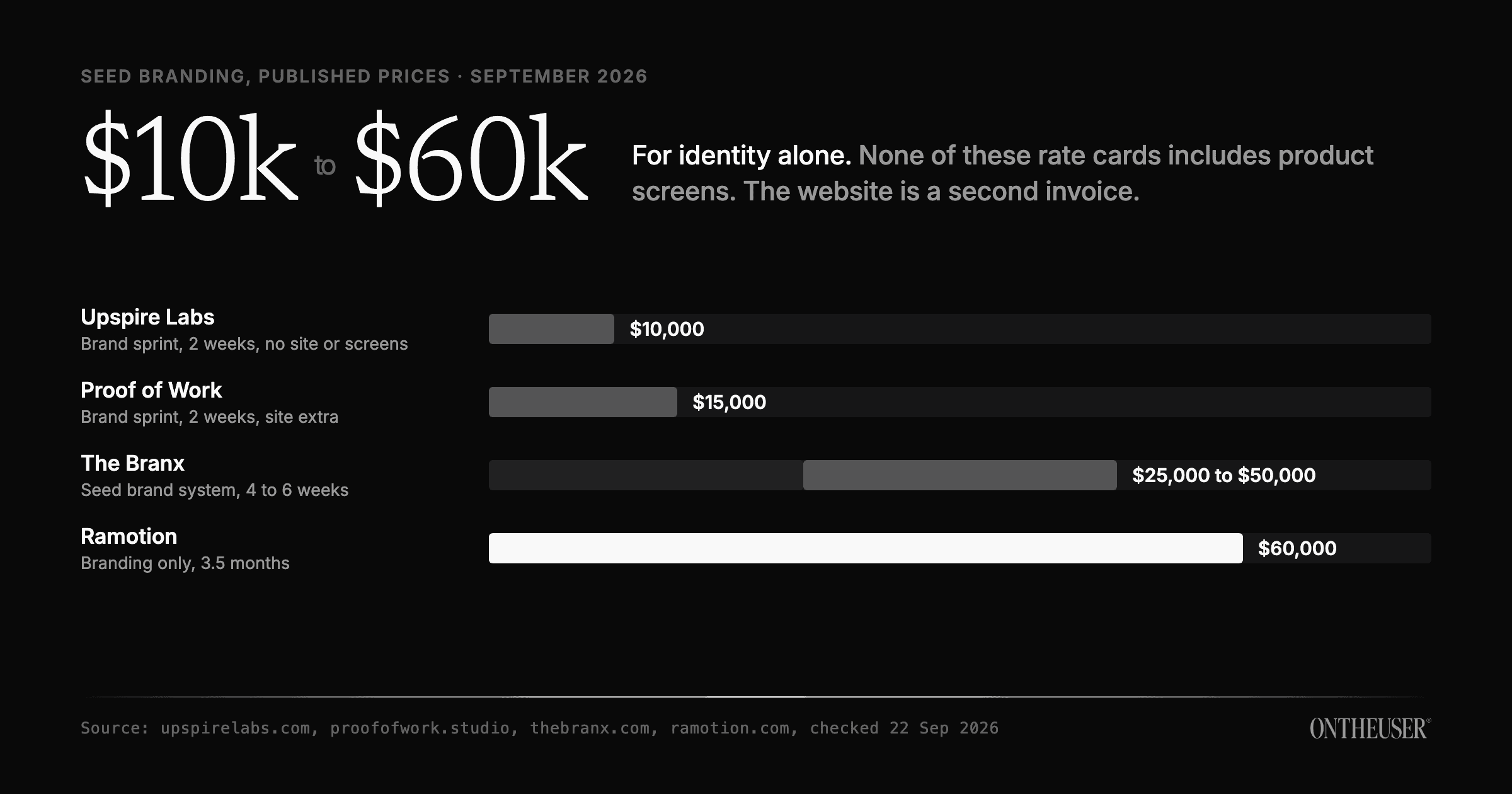
Identity-only rate cards, as published on 22 September 2026. Not one of the four includes product screens, and the website is a separate invoice.
Do the napkin math on the two ends. The sprint route is $10,000 for identity plus $10,000 to $20,000 for a site: $20,000 to $35,000 across two vendors, and the product screens are still undesigned. The full-agency route at Ramotion is $60,000 plus $25,000 to $60,000 for the website: $85,000 to $120,000 over three and a half months, and product design sits in a separate package.
Clutch's review data adds the number that should worry a seed founder most: the typical branding project runs eight months. That is a large share of seed runway spent before anyone touches the product.
FREE GUIDE
The 4 product leaks costing you growth
A short audit guide for founders. Find the four places your product leaks revenue, and what to fix first.
What does a seed-stage founder actually need from branding?
Enough brand that a stranger trusts your landing page and your first screens in the few seconds they give them.
That is the whole job. Stanford's Persuasive Technology Lab put it plainly in its web credibility guidelines: "people quickly evaluate a site by visual design alone." Your user never reads your brand strategy. They glance at a page, then an app, and decide whether a real company shipped it.
Before launch, a brand comes down to four decisions. They are the ones we teach in our free guide, the AI App Launchpad, and brand is what week one of a Zero to One engagement is for:
Voice. Three words from your positioning that decide how every headline and error message sounds.
A visual kit. A type pairing and color palette chosen from combinations already known to work, not invented from scratch.
A wordmark. Your name, set in your type, in your primary color. That is your logo for now. A symbol can come after you have users.
A small component system. Buttons, cards, navigation and one page template, built in Figma so the screens and the landing page come from the same parts.
The fourth is where identity projects stop and where trust lives. Credibility is consistency. A landing page in one font and an app in another tells a visitor that nobody is in charge, and they will not hand a half-finished-looking product their data or their card.
What should you buy, and what should you skip?
Buy the decisions that show up on screen. Skip the artifacts that live in a folder.
Item | At pre-seed and seed | Why | When it becomes worth buying |
|---|---|---|---|
Voice and messaging | Buy | It shapes every headline, button and onboarding line | Now |
Type, color, wordmark | Buy | The minimum that makes page and product look like one company | Now |
Component system applied to key flows | Buy | This is where the brand meets the user | Now |
Landing page in the brand | Buy | The first surface investors and users see | Now |
Custom symbol or mascot | Skip | Costs weeks, and nobody recognizes a symbol before they recognize the product | After you have users who know the name |
60-page brand book | Skip | Written for a team of designers you do not have yet | When a second designer or an in-house team joins |
Naming research | Skip, unless you have no name | A name is decided in days, not paid research | Only if trademark or domain forces it |
Merch, stationery, social template packs | Skip | Nobody converts because of a tote bag | After product-market fit |
Full rebrand | Skip | A rebrand before traction reshuffles the look of a product nobody uses yet | When the brand, not the product, is what holds you back |
That last column is a sequencing call, not a verdict. Each item earns its cost at some stage. Seed is rarely it.
Why buy the brand together with the flows and landing page?
Because the brand only earns trust where users meet it, and the rate cards we checked sell those surfaces as separate projects.
Upspire excludes website and product screens. Proof of Work excludes product UI and sells the website as a second sprint. Ramotion prices branding, website and product design as three packages. Each is sensible alone. The trouble is what happens between them.
A founder who buys them separately gets a brand designed before anyone knew what the key screens needed to say, a website designed by a second team reading a PDF, and product screens designed later by whoever is available. Three handoffs, three chances for the brand to drift. Every drift is visible to the one person you are trying to convince.
Bought together, the brand is designed against the real screens. The type is chosen to hold a dense dashboard, not just a hero headline. The color is tested on an error state, not only a logo. The landing page promises exactly what the first screens deliver, and that match is what a first user or investor reads as trust.
This is what we saw with Helios Hockey. They came to us with a validated idea and no product. We designed the brand system and the MVP flows, plus investor materials, and they raised $1.94 million with them before the full product existed. The brand did not do that alone. The brand on designed flows did, because an investor could touch something that already felt like a company.
If you are still deciding what those key flows are, start with what to build first when you have an idea and no users. If you are not sure the idea deserves a brand yet, validate the startup idea before you build it. Branding an unvalidated idea is the most expensive way to find out nobody wants it.
When is a standalone branding agency the right call?
When the product already exists and works, and the brand is the specific thing holding it back.
There are real cases for the $60,000 identity project:
You have traction and a brand that undersells it. Users stay, but the look loses you enterprise deals or a fundraise.
You sell to consumers on brand. Consumer categories, especially physical ones with packaging, compete on identity in a way B2B software at seed does not.
You have a design team to hand it to. A brand book pays off when designers will read it.
Even then, a redesign or rebrand only moves numbers when it targets the place the numbers break. We wrote about that failure mode in why your redesign did not move the numbers. The same logic holds for brand: a beautiful identity laid over an onboarding flow that loses users on screen two changes the look of the leak, not the leak.
What should you ask a branding agency before you sign?
Ask which screens the brand will be tested on, and who designs them.
Four questions separate a brand you can use from a brand you file:
Is my landing page designed in scope, or only "brand-ready assets"?
Will the system be applied to real product screens before handoff, and by whom?
What is the timeline in weeks, and what am I not shipping while I wait?
What would you cut from this scope to fit a seed budget?
The last is the best one. A good agency answers it immediately. One that cannot has priced the scope first and your stage second.
Our own answer to that question is Zero to One: four weeks, covering a brand (or a small rebrand), the key flows of your product designed, and a landing page, at a fixed fee we quote on the call. It is deliberately smaller than the packages above. No brand book, no naming research, and no build: we design the product, we do not develop it. Investor materials are an add-on priced on top, and a fast one, because you bring the numbers and the story and we design them. What it gives you is one brand carried through every surface a first user or investor touches, in about a month instead of eight. We take two founders a month, with a validated idea and the money to build it raised or being raised.
WHAT NEXT
Want this fixed in your product, not just explained?


Sep 30, 2026
By Victor Teran
Startup Branding: What to Buy From an Agency, and What to Skip
Seed-stage branding from a startup branding agency costs $25,000 to $50,000 on one ranking agency's own guide. At seed, the part that earns trust is the brand on your first screens and landing page, and identity projects rarely include the screens.
Build
Zero to One
Branding
A seed-stage brand system from a startup branding agency costs $25,000 to $50,000, according to the pricing guide published by the agency that ranks first for that search. That is real money at pre-seed, spent on the wrong half of the job.
The logo is not where trust gets decided. Trust gets decided on the landing page and the first three screens of the product, the only places a stranger or an investor ever meets your brand. Buy the brand on those surfaces, or you have bought a very nice PDF.
Below: what agencies charge on their own published pages as of September 2026, what to buy, and what to skip.
Key takeaways
Published startup branding prices run from $10,000 for a two-week identity sprint to $60,000 for a branding-only agency package, as of September 2026.
At seed, brand is the trust layer on your landing page and first product screens. A logo nobody sees next to a working flow does not earn trust on its own.
None of the three agency rate cards in this post includes product screens. Identity, website and product UI are sold as separate projects.
Buy the brand together with the key flows and the landing page, so one decision carries through every surface a user or investor touches.
Skip the brand book, the symbol, naming research and the merch kit until you have users. They cost the most and change the least at this stage.
How much does a startup branding agency cost in 2026?
Between $10,000 and $60,000 for identity alone, on the prices agencies publish themselves, and more once a website is added.
Most agencies hide their price behind a contact form. These are the ones that publish it, checked on 22 September 2026.
Source | What you get | Published price | Timeline |
|---|---|---|---|
Logo system, messaging, visual guidelines. No website, no product screens | $10,000 fixed | 2 weeks | |
Positioning, logo suite, color and type, guidelines, pitch deck template. Product UI excluded, website sold separately ($10,000 to $20,000) | $15,000 fixed | 2 weeks | |
Their band for a seed-stage full brand system | $25,000 to $50,000 | 4 to 6 weeks | |
Brand strategy and visual identity. A 1 to 5 page website is $25,000 to $60,000 on top | $60,000, branding only | 3.5 months | |
Verified client reviews across branding agencies | Most projects $10,000 to $49,999 | Typical 8 months |
Identity-only rate cards, as published on 22 September 2026. Not one of the four includes product screens, and the website is a separate invoice.
Do the napkin math on the two ends. The sprint route is $10,000 for identity plus $10,000 to $20,000 for a site: $20,000 to $35,000 across two vendors, and the product screens are still undesigned. The full-agency route at Ramotion is $60,000 plus $25,000 to $60,000 for the website: $85,000 to $120,000 over three and a half months, and product design sits in a separate package.
Clutch's review data adds the number that should worry a seed founder most: the typical branding project runs eight months. That is a large share of seed runway spent before anyone touches the product.
FREE GUIDE
The 4 product leaks costing you growth
A short audit guide for founders. Find the four places your product leaks revenue, and what to fix first.
What does a seed-stage founder actually need from branding?
Enough brand that a stranger trusts your landing page and your first screens in the few seconds they give them.
That is the whole job. Stanford's Persuasive Technology Lab put it plainly in its web credibility guidelines: "people quickly evaluate a site by visual design alone." Your user never reads your brand strategy. They glance at a page, then an app, and decide whether a real company shipped it.
Before launch, a brand comes down to four decisions. They are the ones we teach in our free guide, the AI App Launchpad, and brand is what week one of a Zero to One engagement is for:
Voice. Three words from your positioning that decide how every headline and error message sounds.
A visual kit. A type pairing and color palette chosen from combinations already known to work, not invented from scratch.
A wordmark. Your name, set in your type, in your primary color. That is your logo for now. A symbol can come after you have users.
A small component system. Buttons, cards, navigation and one page template, built in Figma so the screens and the landing page come from the same parts.
The fourth is where identity projects stop and where trust lives. Credibility is consistency. A landing page in one font and an app in another tells a visitor that nobody is in charge, and they will not hand a half-finished-looking product their data or their card.
What should you buy, and what should you skip?
Buy the decisions that show up on screen. Skip the artifacts that live in a folder.
Item | At pre-seed and seed | Why | When it becomes worth buying |
|---|---|---|---|
Voice and messaging | Buy | It shapes every headline, button and onboarding line | Now |
Type, color, wordmark | Buy | The minimum that makes page and product look like one company | Now |
Component system applied to key flows | Buy | This is where the brand meets the user | Now |
Landing page in the brand | Buy | The first surface investors and users see | Now |
Custom symbol or mascot | Skip | Costs weeks, and nobody recognizes a symbol before they recognize the product | After you have users who know the name |
60-page brand book | Skip | Written for a team of designers you do not have yet | When a second designer or an in-house team joins |
Naming research | Skip, unless you have no name | A name is decided in days, not paid research | Only if trademark or domain forces it |
Merch, stationery, social template packs | Skip | Nobody converts because of a tote bag | After product-market fit |
Full rebrand | Skip | A rebrand before traction reshuffles the look of a product nobody uses yet | When the brand, not the product, is what holds you back |
That last column is a sequencing call, not a verdict. Each item earns its cost at some stage. Seed is rarely it.
Why buy the brand together with the flows and landing page?
Because the brand only earns trust where users meet it, and the rate cards we checked sell those surfaces as separate projects.
Upspire excludes website and product screens. Proof of Work excludes product UI and sells the website as a second sprint. Ramotion prices branding, website and product design as three packages. Each is sensible alone. The trouble is what happens between them.
A founder who buys them separately gets a brand designed before anyone knew what the key screens needed to say, a website designed by a second team reading a PDF, and product screens designed later by whoever is available. Three handoffs, three chances for the brand to drift. Every drift is visible to the one person you are trying to convince.
Bought together, the brand is designed against the real screens. The type is chosen to hold a dense dashboard, not just a hero headline. The color is tested on an error state, not only a logo. The landing page promises exactly what the first screens deliver, and that match is what a first user or investor reads as trust.
This is what we saw with Helios Hockey. They came to us with a validated idea and no product. We designed the brand system and the MVP flows, plus investor materials, and they raised $1.94 million with them before the full product existed. The brand did not do that alone. The brand on designed flows did, because an investor could touch something that already felt like a company.
If you are still deciding what those key flows are, start with what to build first when you have an idea and no users. If you are not sure the idea deserves a brand yet, validate the startup idea before you build it. Branding an unvalidated idea is the most expensive way to find out nobody wants it.
When is a standalone branding agency the right call?
When the product already exists and works, and the brand is the specific thing holding it back.
There are real cases for the $60,000 identity project:
You have traction and a brand that undersells it. Users stay, but the look loses you enterprise deals or a fundraise.
You sell to consumers on brand. Consumer categories, especially physical ones with packaging, compete on identity in a way B2B software at seed does not.
You have a design team to hand it to. A brand book pays off when designers will read it.
Even then, a redesign or rebrand only moves numbers when it targets the place the numbers break. We wrote about that failure mode in why your redesign did not move the numbers. The same logic holds for brand: a beautiful identity laid over an onboarding flow that loses users on screen two changes the look of the leak, not the leak.
What should you ask a branding agency before you sign?
Ask which screens the brand will be tested on, and who designs them.
Four questions separate a brand you can use from a brand you file:
Is my landing page designed in scope, or only "brand-ready assets"?
Will the system be applied to real product screens before handoff, and by whom?
What is the timeline in weeks, and what am I not shipping while I wait?
What would you cut from this scope to fit a seed budget?
The last is the best one. A good agency answers it immediately. One that cannot has priced the scope first and your stage second.
Our own answer to that question is Zero to One: four weeks, covering a brand (or a small rebrand), the key flows of your product designed, and a landing page, at a fixed fee we quote on the call. It is deliberately smaller than the packages above. No brand book, no naming research, and no build: we design the product, we do not develop it. Investor materials are an add-on priced on top, and a fast one, because you bring the numbers and the story and we design them. What it gives you is one brand carried through every surface a first user or investor touches, in about a month instead of eight. We take two founders a month, with a validated idea and the money to build it raised or being raised.
WHAT NEXT
Want this fixed in your product, not just explained?
Sep 30, 2026
By Victor Teran
Startup Branding: What to Buy From an Agency, and What to Skip
Seed-stage branding from a startup branding agency costs $25,000 to $50,000 on one ranking agency's own guide. At seed, the part that earns trust is the brand on your first screens and landing page, and identity projects rarely include the screens.
Build
Zero to One
Branding
A seed-stage brand system from a startup branding agency costs $25,000 to $50,000, according to the pricing guide published by the agency that ranks first for that search. That is real money at pre-seed, spent on the wrong half of the job.
The logo is not where trust gets decided. Trust gets decided on the landing page and the first three screens of the product, the only places a stranger or an investor ever meets your brand. Buy the brand on those surfaces, or you have bought a very nice PDF.
Below: what agencies charge on their own published pages as of September 2026, what to buy, and what to skip.
Key takeaways
Published startup branding prices run from $10,000 for a two-week identity sprint to $60,000 for a branding-only agency package, as of September 2026.
At seed, brand is the trust layer on your landing page and first product screens. A logo nobody sees next to a working flow does not earn trust on its own.
None of the three agency rate cards in this post includes product screens. Identity, website and product UI are sold as separate projects.
Buy the brand together with the key flows and the landing page, so one decision carries through every surface a user or investor touches.
Skip the brand book, the symbol, naming research and the merch kit until you have users. They cost the most and change the least at this stage.
How much does a startup branding agency cost in 2026?
Between $10,000 and $60,000 for identity alone, on the prices agencies publish themselves, and more once a website is added.
Most agencies hide their price behind a contact form. These are the ones that publish it, checked on 22 September 2026.
Source | What you get | Published price | Timeline |
|---|---|---|---|
Logo system, messaging, visual guidelines. No website, no product screens | $10,000 fixed | 2 weeks | |
Positioning, logo suite, color and type, guidelines, pitch deck template. Product UI excluded, website sold separately ($10,000 to $20,000) | $15,000 fixed | 2 weeks | |
Their band for a seed-stage full brand system | $25,000 to $50,000 | 4 to 6 weeks | |
Brand strategy and visual identity. A 1 to 5 page website is $25,000 to $60,000 on top | $60,000, branding only | 3.5 months | |
Verified client reviews across branding agencies | Most projects $10,000 to $49,999 | Typical 8 months |
Identity-only rate cards, as published on 22 September 2026. Not one of the four includes product screens, and the website is a separate invoice.
Do the napkin math on the two ends. The sprint route is $10,000 for identity plus $10,000 to $20,000 for a site: $20,000 to $35,000 across two vendors, and the product screens are still undesigned. The full-agency route at Ramotion is $60,000 plus $25,000 to $60,000 for the website: $85,000 to $120,000 over three and a half months, and product design sits in a separate package.
Clutch's review data adds the number that should worry a seed founder most: the typical branding project runs eight months. That is a large share of seed runway spent before anyone touches the product.
FREE GUIDE
The 4 product leaks costing you growth
A short audit guide for founders. Find the four places your product leaks revenue, and what to fix first.
What does a seed-stage founder actually need from branding?
Enough brand that a stranger trusts your landing page and your first screens in the few seconds they give them.
That is the whole job. Stanford's Persuasive Technology Lab put it plainly in its web credibility guidelines: "people quickly evaluate a site by visual design alone." Your user never reads your brand strategy. They glance at a page, then an app, and decide whether a real company shipped it.
Before launch, a brand comes down to four decisions. They are the ones we teach in our free guide, the AI App Launchpad, and brand is what week one of a Zero to One engagement is for:
Voice. Three words from your positioning that decide how every headline and error message sounds.
A visual kit. A type pairing and color palette chosen from combinations already known to work, not invented from scratch.
A wordmark. Your name, set in your type, in your primary color. That is your logo for now. A symbol can come after you have users.
A small component system. Buttons, cards, navigation and one page template, built in Figma so the screens and the landing page come from the same parts.
The fourth is where identity projects stop and where trust lives. Credibility is consistency. A landing page in one font and an app in another tells a visitor that nobody is in charge, and they will not hand a half-finished-looking product their data or their card.
What should you buy, and what should you skip?
Buy the decisions that show up on screen. Skip the artifacts that live in a folder.
Item | At pre-seed and seed | Why | When it becomes worth buying |
|---|---|---|---|
Voice and messaging | Buy | It shapes every headline, button and onboarding line | Now |
Type, color, wordmark | Buy | The minimum that makes page and product look like one company | Now |
Component system applied to key flows | Buy | This is where the brand meets the user | Now |
Landing page in the brand | Buy | The first surface investors and users see | Now |
Custom symbol or mascot | Skip | Costs weeks, and nobody recognizes a symbol before they recognize the product | After you have users who know the name |
60-page brand book | Skip | Written for a team of designers you do not have yet | When a second designer or an in-house team joins |
Naming research | Skip, unless you have no name | A name is decided in days, not paid research | Only if trademark or domain forces it |
Merch, stationery, social template packs | Skip | Nobody converts because of a tote bag | After product-market fit |
Full rebrand | Skip | A rebrand before traction reshuffles the look of a product nobody uses yet | When the brand, not the product, is what holds you back |
That last column is a sequencing call, not a verdict. Each item earns its cost at some stage. Seed is rarely it.
Why buy the brand together with the flows and landing page?
Because the brand only earns trust where users meet it, and the rate cards we checked sell those surfaces as separate projects.
Upspire excludes website and product screens. Proof of Work excludes product UI and sells the website as a second sprint. Ramotion prices branding, website and product design as three packages. Each is sensible alone. The trouble is what happens between them.
A founder who buys them separately gets a brand designed before anyone knew what the key screens needed to say, a website designed by a second team reading a PDF, and product screens designed later by whoever is available. Three handoffs, three chances for the brand to drift. Every drift is visible to the one person you are trying to convince.
Bought together, the brand is designed against the real screens. The type is chosen to hold a dense dashboard, not just a hero headline. The color is tested on an error state, not only a logo. The landing page promises exactly what the first screens deliver, and that match is what a first user or investor reads as trust.
This is what we saw with Helios Hockey. They came to us with a validated idea and no product. We designed the brand system and the MVP flows, plus investor materials, and they raised $1.94 million with them before the full product existed. The brand did not do that alone. The brand on designed flows did, because an investor could touch something that already felt like a company.
If you are still deciding what those key flows are, start with what to build first when you have an idea and no users. If you are not sure the idea deserves a brand yet, validate the startup idea before you build it. Branding an unvalidated idea is the most expensive way to find out nobody wants it.
When is a standalone branding agency the right call?
When the product already exists and works, and the brand is the specific thing holding it back.
There are real cases for the $60,000 identity project:
You have traction and a brand that undersells it. Users stay, but the look loses you enterprise deals or a fundraise.
You sell to consumers on brand. Consumer categories, especially physical ones with packaging, compete on identity in a way B2B software at seed does not.
You have a design team to hand it to. A brand book pays off when designers will read it.
Even then, a redesign or rebrand only moves numbers when it targets the place the numbers break. We wrote about that failure mode in why your redesign did not move the numbers. The same logic holds for brand: a beautiful identity laid over an onboarding flow that loses users on screen two changes the look of the leak, not the leak.
What should you ask a branding agency before you sign?
Ask which screens the brand will be tested on, and who designs them.
Four questions separate a brand you can use from a brand you file:
Is my landing page designed in scope, or only "brand-ready assets"?
Will the system be applied to real product screens before handoff, and by whom?
What is the timeline in weeks, and what am I not shipping while I wait?
What would you cut from this scope to fit a seed budget?
The last is the best one. A good agency answers it immediately. One that cannot has priced the scope first and your stage second.
Our own answer to that question is Zero to One: four weeks, covering a brand (or a small rebrand), the key flows of your product designed, and a landing page, at a fixed fee we quote on the call. It is deliberately smaller than the packages above. No brand book, no naming research, and no build: we design the product, we do not develop it. Investor materials are an add-on priced on top, and a fast one, because you bring the numbers and the story and we design them. What it gives you is one brand carried through every surface a first user or investor touches, in about a month instead of eight. We take two founders a month, with a validated idea and the money to build it raised or being raised.
WHAT NEXT