
Sep 25, 2026
By Victor Teran
PostHog vs Amplitude: A Founder's Verdict From Work in Both
Q.AI took activation from 38% to 67% on Amplitude. Our own funnel runs on PostHog. Neither result came from the tool. Here is the honest pick by situation, with September 2026 pricing, and the one decision that matters more than either logo.
Analytics
PostHog
Amplitude
Q.AI took activation from 38% to 67% with Amplitude as the analytics stack. Our own site funnel runs on PostHog. If the tool were the lever, one of those would have gone badly, and neither did.
That is the verdict before the comparison: for a seed to Series A product, PostHog and Amplitude will both show you where users leave. The expensive mistake is not picking the wrong one. It is installing either before anyone can say, in one sentence, what an activated user does.
Below is what we checked, what it costs as of September 2026, and which one to pick for which situation. Where we have not run a feature ourselves, we say what we read instead.
Key takeaways
For an early-stage SaaS product, PostHog and Amplitude both cover funnels, session replay and feature flags well enough; the activation definition you feed them decides the outcome.
Q.AI's activation rose from 38% to 67%, onboarding completion rose 68% and support tickets fell 73% with Amplitude as the stack; the method did the work, not the tool.
As of September 2026, Amplitude's free plan is larger (2M events and 10K session replays a month) than PostHog's (1M events and 5K recordings), and both need no credit card.
PostHog is fully self-serve with published per-unit prices; Amplitude's Growth and Enterprise plans are custom priced through sales.
Both offer EU hosting: PostHog in Frankfurt, and Amplitude lists an EU data center option on every plan.
Which is better for a startup, PostHog or Amplitude?
Pick PostHog if engineers set up your analytics and you want one bill for replays, flags and experiments; pick Amplitude if a non-technical team will live in the charts and you qualify for its startup year.
That is the honest split. Both products now sell the same bundle on paper: product analytics, session replay, feature flags, experiments and surveys. The difference is in who the product is built for and how it charges.
PostHog is built for the people who write the code. It prices every product separately, publishes every rate, and lets you set a billing limit per product. Amplitude is built for product and growth teams who want answers without writing queries, and it saves its best volume and features for plans you negotiate.
We default to PostHog. It is the tool in our audit stack, and our own site runs on it: a PostHog project on its EU cloud, with two events carrying the whole funnel, signed_up and call_booked. That is a preference, not a ranking. Our flagship case ran on Amplitude.
Did the tool matter in the Q.AI engagement?
No. Activation went from 38% to 67% because the team defined the funnel and read it, and Amplitude was simply where the data lived.
Q.AI arrived with a growing user base and a retention curve nobody could explain. Their stack was Amplitude. What went in was a funnel across the new-user path: signup, the onboarding steps, first core action, return session. The funnel showed the cliff. Session replays of new users who hit those steps and left showed the reason. Only the implicated screens were redesigned.
The results: activation from 38% to 67%, a 29 point rise, onboarding completion up 68%, support tickets down 73%. Q.AI was later acquired by Forbes. The full anatomy of that engagement is written up step by step.
Nothing in that sequence is Amplitude-specific. Swap the logo for PostHog and every step runs the same: PostHog funnels and Amplitude funnels answer the same question, which is where the survival rate falls hardest between two steps. We wrote down how to read that funnel without a data team; the reading transfers to either tool.
FREE GUIDE
The 4 product leaks costing you growth
A short audit guide for founders. Find the four places your product leaks revenue, and what to fix first.
What do PostHog and Amplitude cost in September 2026?
Both start free with no credit card; Amplitude's free allowance is bigger, and PostHog is the only one that publishes what you pay after it.
We checked both pricing pages on 22 September 2026. PostHog's pricing and Amplitude's pricing as listed that day:
PostHog | Amplitude | |
|---|---|---|
Free analytics volume | 1M events a month | 2M events a month |
Free session replay | 5K recordings a month | 10K session replays a month |
Feature flags on free | 1M requests a month | Unlimited |
Experiments on free | Billed with feature flags | 1 active experiment |
Credit card to start | Not required | Not required |
After free tier | $0.000198 per identified event, $0.00005 per anonymous event, $0.005 per recording | Plus "starts at $0", scales by event volume to 70M; card required |
Upper plans | Boost $250/mo, Scale $750/mo, Enterprise by contact | Growth and Enterprise, custom, contact sales |
Replay retention | 1 month free, 90 days pay-as-you-go | 1 month on every plan; add-on for more on Growth and Enterprise |
EU hosting | EU cloud (Frankfurt) | EU data center option listed on all plans |
Startup program | $50,000 credits for 12 months, under 2 years old and under $5M raised | Growth plan free for year one, under 20 staff and under $10M raised |
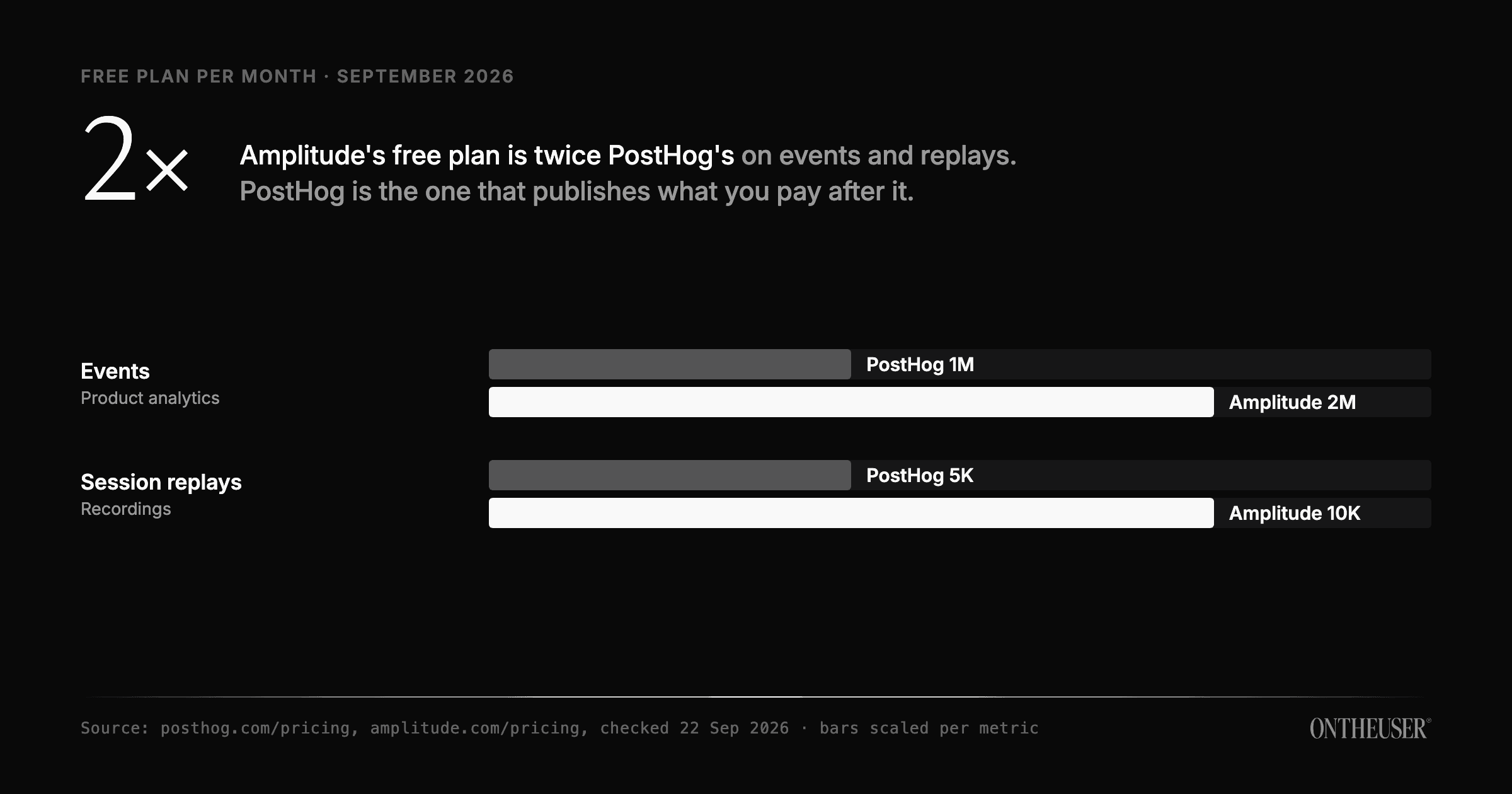
Amplitude's free plan is twice PostHog's on events and replays. Source: both pricing pages, checked 22 September 2026.
Now the napkin math, because the free tiers flatter both. Take a seed product sending 1.5M identified events and 8,000 replays a month. On PostHog that is 500,000 paid events at $0.000198, which is $99, plus 3,000 paid recordings at $0.005, which is $15. Call it $114 a month. On Amplitude's free plan, the same volume costs $0.
So on list price, Amplitude wins the early months. At $114 a month the difference is $1,368 a year, which is real money at seed and still less than one wrong redesign.
Two footnotes change the math. PostHog charges a quarter of the price for anonymous events, so a product that only identifies users at signup pays far less than the identified rate suggests. And Amplitude's startup program gives its full Growth plan free for a year to companies under 20 staff and under $10M raised, while PostHog's gives $50,000 in credits for 12 months to companies under two years old and under $5M raised. If you qualify for one, your first year on that tool is close to free.
How do session replay, feature flags and experiments compare?
Both bundle them; PostHog meters each one separately and lets it grow, while Amplitude includes a fixed allowance per plan and sells the rest as add-ons.
Session replay is where most of our diagnosis happens, because the funnel tells you where and the replay tells you why. PostHog session replay is part of our audit stack. We have read Amplitude's replay docs and pricing, not run it at volume ourselves. On paper, Amplitude gives you 10,000 replays free and 20,000 on Growth, with longer retention as an add-on. PostHog gives 5,000 free and then charges per recording, with no plan cap and a billing limit you set yourself.
Feature flags favor Amplitude on the free plan: it lists unlimited flags on every plan, while PostHog meters flag requests, 1M free a month. Experiments favor PostHog: Amplitude's Free and Plus plans allow one active experiment, and unlimited experiments are a Growth and Enterprise add-on. If you plan to run two tests at once before you have a sales contract, that limit decides it.
Which one is self-serve, and which one ends in a sales call?
PostHog is self-serve up to its Enterprise package; Amplitude is self-serve through Plus, then every plan above it is custom priced.
This matters more to founders than any feature row. PostHog lists every rate, lets you cap each product's bill, and states it has no minimums or annual commitments. You can go from free to a five-figure bill without speaking to anyone, which is a feature and, if you forget the billing limit, a risk.
Amplitude's Plus plan is card-and-go up to 70M events. Past that, or the moment you want SSO, more replays or unlimited experiments, you are in Growth or Enterprise, and both say "contact sales". That is not a flaw. It is a different buying motion, and it suits a team that wants a customer success manager more than it wants a price list.
Which should you pick for your situation?
Match the tool to who will use it and how you buy, then stop deliberating, because a week spent choosing is a week the funnel stays unread.
Your situation | Pick | Why |
|---|---|---|
Technical founder, engineers own tracking | PostHog | Published rates, per-product billing limits, flags and experiments in one bill |
Product or growth team with no engineer spare | Amplitude | Built for chart users, larger free plan |
Under 20 staff and under $10M raised | Amplitude, then compare at month 11 | A free year of the Growth plan |
Under 2 years old and under $5M raised | PostHog | $50,000 in credits for 12 months |
EU users, data must stay in the EU | Either | PostHog EU cloud (Frankfurt); Amplitude EU data center option |
Two or more experiments running at once, no sales contract | PostHog | Amplitude Free and Plus allow one active experiment |
Procurement wants a contract and an account manager | Amplitude | Growth and Enterprise are sold that way |
If you are already on one of them with the funnel instrumented, do not migrate over a pricing row. The before-and-after comparison is the asset, and a new tool starts it over.
What should you do before you install either?
Write your activation event in one sentence and build one funnel that ends on it; without that, both tools produce charts nobody acts on.
Most stalled products we audit share the same gap: nobody on the team can name the activation event in one sentence. The tool records everything and answers nothing, because nobody told it what a successful first session looks like.
So the order is fixed. Name the event. Build one new-user funnel of five to seven steps that ends on it. Find the steepest drop between two adjacent steps. Watch five replays of users who fell there. Fix that screen and measure the same funnel again. That is the sequence that took Q.AI from 38% to 67%, and it ran in Amplitude. The same funnel logic runs in PostHog on our own site.
Pick the tool this afternoon. Spend the week on the definition.
WHAT NEXT
Want this fixed in your product, not just explained?


Sep 25, 2026
By Victor Teran
PostHog vs Amplitude: A Founder's Verdict From Work in Both
Q.AI took activation from 38% to 67% on Amplitude. Our own funnel runs on PostHog. Neither result came from the tool. Here is the honest pick by situation, with September 2026 pricing, and the one decision that matters more than either logo.
Analytics
PostHog
Amplitude
Q.AI took activation from 38% to 67% with Amplitude as the analytics stack. Our own site funnel runs on PostHog. If the tool were the lever, one of those would have gone badly, and neither did.
That is the verdict before the comparison: for a seed to Series A product, PostHog and Amplitude will both show you where users leave. The expensive mistake is not picking the wrong one. It is installing either before anyone can say, in one sentence, what an activated user does.
Below is what we checked, what it costs as of September 2026, and which one to pick for which situation. Where we have not run a feature ourselves, we say what we read instead.
Key takeaways
For an early-stage SaaS product, PostHog and Amplitude both cover funnels, session replay and feature flags well enough; the activation definition you feed them decides the outcome.
Q.AI's activation rose from 38% to 67%, onboarding completion rose 68% and support tickets fell 73% with Amplitude as the stack; the method did the work, not the tool.
As of September 2026, Amplitude's free plan is larger (2M events and 10K session replays a month) than PostHog's (1M events and 5K recordings), and both need no credit card.
PostHog is fully self-serve with published per-unit prices; Amplitude's Growth and Enterprise plans are custom priced through sales.
Both offer EU hosting: PostHog in Frankfurt, and Amplitude lists an EU data center option on every plan.
Which is better for a startup, PostHog or Amplitude?
Pick PostHog if engineers set up your analytics and you want one bill for replays, flags and experiments; pick Amplitude if a non-technical team will live in the charts and you qualify for its startup year.
That is the honest split. Both products now sell the same bundle on paper: product analytics, session replay, feature flags, experiments and surveys. The difference is in who the product is built for and how it charges.
PostHog is built for the people who write the code. It prices every product separately, publishes every rate, and lets you set a billing limit per product. Amplitude is built for product and growth teams who want answers without writing queries, and it saves its best volume and features for plans you negotiate.
We default to PostHog. It is the tool in our audit stack, and our own site runs on it: a PostHog project on its EU cloud, with two events carrying the whole funnel, signed_up and call_booked. That is a preference, not a ranking. Our flagship case ran on Amplitude.
Did the tool matter in the Q.AI engagement?
No. Activation went from 38% to 67% because the team defined the funnel and read it, and Amplitude was simply where the data lived.
Q.AI arrived with a growing user base and a retention curve nobody could explain. Their stack was Amplitude. What went in was a funnel across the new-user path: signup, the onboarding steps, first core action, return session. The funnel showed the cliff. Session replays of new users who hit those steps and left showed the reason. Only the implicated screens were redesigned.
The results: activation from 38% to 67%, a 29 point rise, onboarding completion up 68%, support tickets down 73%. Q.AI was later acquired by Forbes. The full anatomy of that engagement is written up step by step.
Nothing in that sequence is Amplitude-specific. Swap the logo for PostHog and every step runs the same: PostHog funnels and Amplitude funnels answer the same question, which is where the survival rate falls hardest between two steps. We wrote down how to read that funnel without a data team; the reading transfers to either tool.
FREE GUIDE
The 4 product leaks costing you growth
A short audit guide for founders. Find the four places your product leaks revenue, and what to fix first.
What do PostHog and Amplitude cost in September 2026?
Both start free with no credit card; Amplitude's free allowance is bigger, and PostHog is the only one that publishes what you pay after it.
We checked both pricing pages on 22 September 2026. PostHog's pricing and Amplitude's pricing as listed that day:
PostHog | Amplitude | |
|---|---|---|
Free analytics volume | 1M events a month | 2M events a month |
Free session replay | 5K recordings a month | 10K session replays a month |
Feature flags on free | 1M requests a month | Unlimited |
Experiments on free | Billed with feature flags | 1 active experiment |
Credit card to start | Not required | Not required |
After free tier | $0.000198 per identified event, $0.00005 per anonymous event, $0.005 per recording | Plus "starts at $0", scales by event volume to 70M; card required |
Upper plans | Boost $250/mo, Scale $750/mo, Enterprise by contact | Growth and Enterprise, custom, contact sales |
Replay retention | 1 month free, 90 days pay-as-you-go | 1 month on every plan; add-on for more on Growth and Enterprise |
EU hosting | EU cloud (Frankfurt) | EU data center option listed on all plans |
Startup program | $50,000 credits for 12 months, under 2 years old and under $5M raised | Growth plan free for year one, under 20 staff and under $10M raised |
Amplitude's free plan is twice PostHog's on events and replays. Source: both pricing pages, checked 22 September 2026.
Now the napkin math, because the free tiers flatter both. Take a seed product sending 1.5M identified events and 8,000 replays a month. On PostHog that is 500,000 paid events at $0.000198, which is $99, plus 3,000 paid recordings at $0.005, which is $15. Call it $114 a month. On Amplitude's free plan, the same volume costs $0.
So on list price, Amplitude wins the early months. At $114 a month the difference is $1,368 a year, which is real money at seed and still less than one wrong redesign.
Two footnotes change the math. PostHog charges a quarter of the price for anonymous events, so a product that only identifies users at signup pays far less than the identified rate suggests. And Amplitude's startup program gives its full Growth plan free for a year to companies under 20 staff and under $10M raised, while PostHog's gives $50,000 in credits for 12 months to companies under two years old and under $5M raised. If you qualify for one, your first year on that tool is close to free.
How do session replay, feature flags and experiments compare?
Both bundle them; PostHog meters each one separately and lets it grow, while Amplitude includes a fixed allowance per plan and sells the rest as add-ons.
Session replay is where most of our diagnosis happens, because the funnel tells you where and the replay tells you why. PostHog session replay is part of our audit stack. We have read Amplitude's replay docs and pricing, not run it at volume ourselves. On paper, Amplitude gives you 10,000 replays free and 20,000 on Growth, with longer retention as an add-on. PostHog gives 5,000 free and then charges per recording, with no plan cap and a billing limit you set yourself.
Feature flags favor Amplitude on the free plan: it lists unlimited flags on every plan, while PostHog meters flag requests, 1M free a month. Experiments favor PostHog: Amplitude's Free and Plus plans allow one active experiment, and unlimited experiments are a Growth and Enterprise add-on. If you plan to run two tests at once before you have a sales contract, that limit decides it.
Which one is self-serve, and which one ends in a sales call?
PostHog is self-serve up to its Enterprise package; Amplitude is self-serve through Plus, then every plan above it is custom priced.
This matters more to founders than any feature row. PostHog lists every rate, lets you cap each product's bill, and states it has no minimums or annual commitments. You can go from free to a five-figure bill without speaking to anyone, which is a feature and, if you forget the billing limit, a risk.
Amplitude's Plus plan is card-and-go up to 70M events. Past that, or the moment you want SSO, more replays or unlimited experiments, you are in Growth or Enterprise, and both say "contact sales". That is not a flaw. It is a different buying motion, and it suits a team that wants a customer success manager more than it wants a price list.
Which should you pick for your situation?
Match the tool to who will use it and how you buy, then stop deliberating, because a week spent choosing is a week the funnel stays unread.
Your situation | Pick | Why |
|---|---|---|
Technical founder, engineers own tracking | PostHog | Published rates, per-product billing limits, flags and experiments in one bill |
Product or growth team with no engineer spare | Amplitude | Built for chart users, larger free plan |
Under 20 staff and under $10M raised | Amplitude, then compare at month 11 | A free year of the Growth plan |
Under 2 years old and under $5M raised | PostHog | $50,000 in credits for 12 months |
EU users, data must stay in the EU | Either | PostHog EU cloud (Frankfurt); Amplitude EU data center option |
Two or more experiments running at once, no sales contract | PostHog | Amplitude Free and Plus allow one active experiment |
Procurement wants a contract and an account manager | Amplitude | Growth and Enterprise are sold that way |
If you are already on one of them with the funnel instrumented, do not migrate over a pricing row. The before-and-after comparison is the asset, and a new tool starts it over.
What should you do before you install either?
Write your activation event in one sentence and build one funnel that ends on it; without that, both tools produce charts nobody acts on.
Most stalled products we audit share the same gap: nobody on the team can name the activation event in one sentence. The tool records everything and answers nothing, because nobody told it what a successful first session looks like.
So the order is fixed. Name the event. Build one new-user funnel of five to seven steps that ends on it. Find the steepest drop between two adjacent steps. Watch five replays of users who fell there. Fix that screen and measure the same funnel again. That is the sequence that took Q.AI from 38% to 67%, and it ran in Amplitude. The same funnel logic runs in PostHog on our own site.
Pick the tool this afternoon. Spend the week on the definition.
WHAT NEXT
Want this fixed in your product, not just explained?
Sep 25, 2026
By Victor Teran
PostHog vs Amplitude: A Founder's Verdict From Work in Both
Q.AI took activation from 38% to 67% on Amplitude. Our own funnel runs on PostHog. Neither result came from the tool. Here is the honest pick by situation, with September 2026 pricing, and the one decision that matters more than either logo.
Analytics
PostHog
Amplitude
Q.AI took activation from 38% to 67% with Amplitude as the analytics stack. Our own site funnel runs on PostHog. If the tool were the lever, one of those would have gone badly, and neither did.
That is the verdict before the comparison: for a seed to Series A product, PostHog and Amplitude will both show you where users leave. The expensive mistake is not picking the wrong one. It is installing either before anyone can say, in one sentence, what an activated user does.
Below is what we checked, what it costs as of September 2026, and which one to pick for which situation. Where we have not run a feature ourselves, we say what we read instead.
Key takeaways
For an early-stage SaaS product, PostHog and Amplitude both cover funnels, session replay and feature flags well enough; the activation definition you feed them decides the outcome.
Q.AI's activation rose from 38% to 67%, onboarding completion rose 68% and support tickets fell 73% with Amplitude as the stack; the method did the work, not the tool.
As of September 2026, Amplitude's free plan is larger (2M events and 10K session replays a month) than PostHog's (1M events and 5K recordings), and both need no credit card.
PostHog is fully self-serve with published per-unit prices; Amplitude's Growth and Enterprise plans are custom priced through sales.
Both offer EU hosting: PostHog in Frankfurt, and Amplitude lists an EU data center option on every plan.
Which is better for a startup, PostHog or Amplitude?
Pick PostHog if engineers set up your analytics and you want one bill for replays, flags and experiments; pick Amplitude if a non-technical team will live in the charts and you qualify for its startup year.
That is the honest split. Both products now sell the same bundle on paper: product analytics, session replay, feature flags, experiments and surveys. The difference is in who the product is built for and how it charges.
PostHog is built for the people who write the code. It prices every product separately, publishes every rate, and lets you set a billing limit per product. Amplitude is built for product and growth teams who want answers without writing queries, and it saves its best volume and features for plans you negotiate.
We default to PostHog. It is the tool in our audit stack, and our own site runs on it: a PostHog project on its EU cloud, with two events carrying the whole funnel, signed_up and call_booked. That is a preference, not a ranking. Our flagship case ran on Amplitude.
Did the tool matter in the Q.AI engagement?
No. Activation went from 38% to 67% because the team defined the funnel and read it, and Amplitude was simply where the data lived.
Q.AI arrived with a growing user base and a retention curve nobody could explain. Their stack was Amplitude. What went in was a funnel across the new-user path: signup, the onboarding steps, first core action, return session. The funnel showed the cliff. Session replays of new users who hit those steps and left showed the reason. Only the implicated screens were redesigned.
The results: activation from 38% to 67%, a 29 point rise, onboarding completion up 68%, support tickets down 73%. Q.AI was later acquired by Forbes. The full anatomy of that engagement is written up step by step.
Nothing in that sequence is Amplitude-specific. Swap the logo for PostHog and every step runs the same: PostHog funnels and Amplitude funnels answer the same question, which is where the survival rate falls hardest between two steps. We wrote down how to read that funnel without a data team; the reading transfers to either tool.
FREE GUIDE
The 4 product leaks costing you growth
A short audit guide for founders. Find the four places your product leaks revenue, and what to fix first.
What do PostHog and Amplitude cost in September 2026?
Both start free with no credit card; Amplitude's free allowance is bigger, and PostHog is the only one that publishes what you pay after it.
We checked both pricing pages on 22 September 2026. PostHog's pricing and Amplitude's pricing as listed that day:
PostHog | Amplitude | |
|---|---|---|
Free analytics volume | 1M events a month | 2M events a month |
Free session replay | 5K recordings a month | 10K session replays a month |
Feature flags on free | 1M requests a month | Unlimited |
Experiments on free | Billed with feature flags | 1 active experiment |
Credit card to start | Not required | Not required |
After free tier | $0.000198 per identified event, $0.00005 per anonymous event, $0.005 per recording | Plus "starts at $0", scales by event volume to 70M; card required |
Upper plans | Boost $250/mo, Scale $750/mo, Enterprise by contact | Growth and Enterprise, custom, contact sales |
Replay retention | 1 month free, 90 days pay-as-you-go | 1 month on every plan; add-on for more on Growth and Enterprise |
EU hosting | EU cloud (Frankfurt) | EU data center option listed on all plans |
Startup program | $50,000 credits for 12 months, under 2 years old and under $5M raised | Growth plan free for year one, under 20 staff and under $10M raised |
Amplitude's free plan is twice PostHog's on events and replays. Source: both pricing pages, checked 22 September 2026.
Now the napkin math, because the free tiers flatter both. Take a seed product sending 1.5M identified events and 8,000 replays a month. On PostHog that is 500,000 paid events at $0.000198, which is $99, plus 3,000 paid recordings at $0.005, which is $15. Call it $114 a month. On Amplitude's free plan, the same volume costs $0.
So on list price, Amplitude wins the early months. At $114 a month the difference is $1,368 a year, which is real money at seed and still less than one wrong redesign.
Two footnotes change the math. PostHog charges a quarter of the price for anonymous events, so a product that only identifies users at signup pays far less than the identified rate suggests. And Amplitude's startup program gives its full Growth plan free for a year to companies under 20 staff and under $10M raised, while PostHog's gives $50,000 in credits for 12 months to companies under two years old and under $5M raised. If you qualify for one, your first year on that tool is close to free.
How do session replay, feature flags and experiments compare?
Both bundle them; PostHog meters each one separately and lets it grow, while Amplitude includes a fixed allowance per plan and sells the rest as add-ons.
Session replay is where most of our diagnosis happens, because the funnel tells you where and the replay tells you why. PostHog session replay is part of our audit stack. We have read Amplitude's replay docs and pricing, not run it at volume ourselves. On paper, Amplitude gives you 10,000 replays free and 20,000 on Growth, with longer retention as an add-on. PostHog gives 5,000 free and then charges per recording, with no plan cap and a billing limit you set yourself.
Feature flags favor Amplitude on the free plan: it lists unlimited flags on every plan, while PostHog meters flag requests, 1M free a month. Experiments favor PostHog: Amplitude's Free and Plus plans allow one active experiment, and unlimited experiments are a Growth and Enterprise add-on. If you plan to run two tests at once before you have a sales contract, that limit decides it.
Which one is self-serve, and which one ends in a sales call?
PostHog is self-serve up to its Enterprise package; Amplitude is self-serve through Plus, then every plan above it is custom priced.
This matters more to founders than any feature row. PostHog lists every rate, lets you cap each product's bill, and states it has no minimums or annual commitments. You can go from free to a five-figure bill without speaking to anyone, which is a feature and, if you forget the billing limit, a risk.
Amplitude's Plus plan is card-and-go up to 70M events. Past that, or the moment you want SSO, more replays or unlimited experiments, you are in Growth or Enterprise, and both say "contact sales". That is not a flaw. It is a different buying motion, and it suits a team that wants a customer success manager more than it wants a price list.
Which should you pick for your situation?
Match the tool to who will use it and how you buy, then stop deliberating, because a week spent choosing is a week the funnel stays unread.
Your situation | Pick | Why |
|---|---|---|
Technical founder, engineers own tracking | PostHog | Published rates, per-product billing limits, flags and experiments in one bill |
Product or growth team with no engineer spare | Amplitude | Built for chart users, larger free plan |
Under 20 staff and under $10M raised | Amplitude, then compare at month 11 | A free year of the Growth plan |
Under 2 years old and under $5M raised | PostHog | $50,000 in credits for 12 months |
EU users, data must stay in the EU | Either | PostHog EU cloud (Frankfurt); Amplitude EU data center option |
Two or more experiments running at once, no sales contract | PostHog | Amplitude Free and Plus allow one active experiment |
Procurement wants a contract and an account manager | Amplitude | Growth and Enterprise are sold that way |
If you are already on one of them with the funnel instrumented, do not migrate over a pricing row. The before-and-after comparison is the asset, and a new tool starts it over.
What should you do before you install either?
Write your activation event in one sentence and build one funnel that ends on it; without that, both tools produce charts nobody acts on.
Most stalled products we audit share the same gap: nobody on the team can name the activation event in one sentence. The tool records everything and answers nothing, because nobody told it what a successful first session looks like.
So the order is fixed. Name the event. Build one new-user funnel of five to seven steps that ends on it. Find the steepest drop between two adjacent steps. Watch five replays of users who fell there. Fix that screen and measure the same funnel again. That is the sequence that took Q.AI from 38% to 67%, and it ran in Amplitude. The same funnel logic runs in PostHog on our own site.
Pick the tool this afternoon. Spend the week on the definition.
WHAT NEXT